


When Tattoos Tell a Dark Story: The Fight to Erase Hate Ink
When Graham Platner, a progressive Democrat running for the U.S. Senate in Maine, posted a topless photo of himself online last week, it wasn’t a publicity stunt — it was an attempt to clear his name.
The image showed a large tattoo on his chest — a Celtic cross and a dog — covering what used to be something far more troubling: a Totenkopf, or skull-and-crossbones design, once worn by the Nazi SS. Platner said he had the tattoo done while drunk and stationed in Croatia as a young marine, with no idea of its historical meaning. When he learned what it symbolized, he covered it up.
But the internet never forgets. A clip from his brother’s wedding — showing the original tattoo — resurfaced and ignited controversy. Platner, who had earned Bernie Sanders’s endorsement and a reputation as a rising progressive, suddenly found himself defending not his policies but his past ink.
His story, while headline-grabbing, is not unique. Every week, tattoo artists and laser-removal specialists across the United States meet people who want to erase or cover up racist or extremist tattoos — physical reminders of old beliefs or bad decisions.
A Hidden Epidemic of Hate Tattoos
Many who seek help for removal once lived inside extremist or violent subcultures — from prison gangs to white supremacist movements. For some, tattoos mark allegiance; for others, they were forced symbols of survival or control.
“Everyone deserves a second chance,” said Kate Widener, owner of Undo Tattoo and Laser in Gresham, Oregon. Widener handles about 70 tattoo removals a week, and roughly a quarter are done free of charge through her community program.
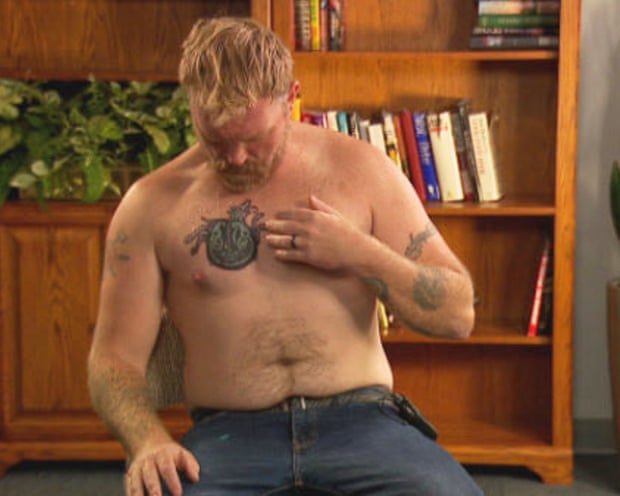 |
| In this photo provided by WGME, Graham Platner points to a cover-up tattoo that had previously been an image recognized as a Nazi symbol during an interview on 22 October in Portland, Maine. Photograph: AP |
“I’ve seen everything — swastikas, SS bolts, racist slogans,” she said. “But if someone asks for help, I’ll listen. My only rule is confidentiality. I don’t ask too many questions.”
Clients come from across the Pacific Northwest — from Seattle, Idaho, and beyond — seeking to erase a visible tie to a hateful past. Some are sincere, others less so. “A few are just hiding it from co-workers,” Widener admitted. “One guy is only removing the swastikas on his face — the rest are still there, from his neck down. You can tell when someone is changing and when someone’s just covering up.”
Changing — or Just Hiding?
That’s a constant question for professionals in this field. Dustin Ortel, director of the Ink-nitiative program at national tattoo-removal chain Removery, says he’s learned to read sincerity in the stories people tell.
“Each applicant has to submit letters from parole officers or counselors,” Ortel explained. “We pick about 300 people each year. You can tell when someone’s genuinely trying to change — I cry with some of them during sessions.”
Removery’s program launched in 2020 and has grown steadily, with thousands applying annually. Many participants are ex-convicts, survivors of extremist groups, or people seeking to rebuild relationships with families they once alienated.
“There’s always emotion in the room,” Ortel said. “For a lot of people, this is the last physical link to a life they want to leave behind.”
Nonprofits and National Networks
Groups like Jails to Jobs, a California-based nonprofit, are helping scale that effort nationally. The organization connects individuals to over 300 free or low-cost tattoo-removal programs in 45 states and several other countries. It even publishes a how-to manual to help communities start their own local initiatives.
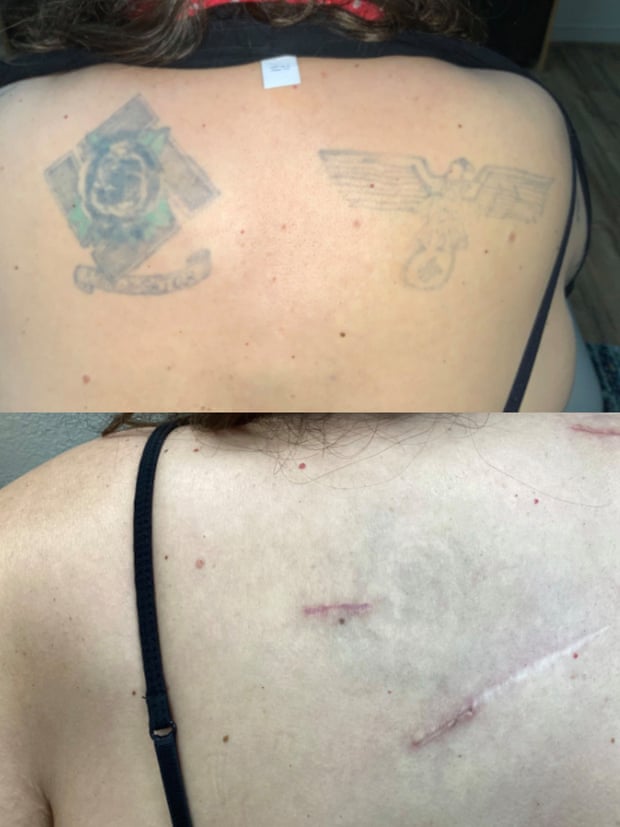 |
| Before and after of tattoo removal done by Removery. Composite: Removery |
Not all tattoos removed through these programs are tied to racism. Some come from gang involvement, human trafficking, or abusive relationships. But far-right symbolism — swastikas, “1488” numerals, Nordic runes — remains a large and visible share.
The Anti-Defamation League’s “Hate on Display” database, which has cataloged extremist symbols since 2000, now spans more than 50 pages — a testament to how embedded such imagery has become in certain subcultures.
Why People Choose to Change
Widener has seen clients’ transformations firsthand. “Sometimes it’s because they fall in love,” she said. One man, raised in a racist household, began dating a woman of color and questioned everything he’d been taught.
“He comes in every six weeks for laser sessions,” Widener said. “He tells me it’s for his son — his mixed-race child. He wants to cover the old hate with something that honors his new family. He cries every time. He’s my favorite client.”
These emotional transformations reflect a deeper truth: belief systems can shift when personal connections challenge ideology.
Politics, Public Events, and Demand
Moments of national tension often drive spikes in tattoo removals. After the 2017 Charlottesville white-nationalist rallies, interest surged. The same happened after George Floyd’s murder in 2020, as protests forced many former extremists to confront what their tattoos represented.
But demand fluctuates. Widener said interest in hate-tattoo removal declined under the Trump administration: “Before Trump, I had a lot more people coming in to erase white-supremacist tattoos. When he was re-elected, one client actually told me, ‘I don’t need to remove it anymore.’”
Despite that dip, her schedule remains full — Undo Tattoo’s free program is booked solid through December. Other programs, like those run by artist Lorenzo Diaz in Michigan, continue to see steady numbers. “I’ve been covering hate tattoos for 17 years,” Diaz said. “I do three to four a week, and they’re usually big pieces.”
The Intimacy of Removal
Tattoo removal is an intimate process, requiring trust and physical proximity. “You have to touch people’s skin, you’re in their space,” Widener explained. “They tell you their stories. You can feel who’s changing — and who’s hiding.”
For all her compassion, she admits there are limits. “I’ve thought about turning people away if I sense they’re still active racists,” she said. “I’m judgment-free, but I know how much harm those symbols cause. I don’t know what the future holds.”
A Culture Rewriting Its Skin
The movement to erase hate tattoos is both symbolic and deeply personal. For some, it’s an act of penance; for others, an act of liberation.
Graham Platner’s campaign controversy may have brought the issue into public view, but the real story lies in countless quiet transformations happening in tattoo studios and clinics across America.
Every laser pulse, every cover-up, is a story of reckoning — a small flash of light cutting through the ink of hate, one session at a time.
You Might Like: Alia Bhatt Is Done Playing By the Rules—This Is Her Era of Self-Definition
Dive Deeper: How Three Iranian-American Sisters Built Naked Wardrobe into a Global Fashion Empire
Trending Now: Blind Date Over 60s Special: ‘She’s Uncomfortable with Compliments, So Only One: Beautiful’
tattoo removal, Nazi tattoos, hate tattoo removal, Graham Platner, tattoo cover-up, far-right symbols, white supremacy tattoos, tattoo artists, Jails to Jobs, Undo Tattoo Oregon, Removery Ink-nitiative, tattoo culture, reformed extremists, tattoo removal programs




