


Would You Accept Donor Fat? Exploring Alloclae, the Next Frontier in Non-Surgical Fat Transfers
Fat is at the center of almost every conversation in modern aesthetics—from weight loss with GLP-1 medications to liposuction, fat grafting, and now, the reuse of fat in revolutionary ways. Plastic surgeons are now testing a first-of-its-kind body filler derived from donor fat: Alloclae. This injectable uses meticulously processed human fat from cadaveric donors, offering a potential alternative to traditional fat grafting and implants.
What is Alloclae?
Alloclae is a thick injectable filler composed of donor adipose tissue combined with extracellular matrix proteins like collagen, elastin, and glycoproteins. Unlike Renuva, a fat-adjacent protein treatment, Alloclae contains nonliving fat cells alongside naturally occurring growth factors. This allows the donor tissue to integrate with the recipient’s body while encouraging new fat cell growth and blood vessel formation.

Designed specifically for body contouring—not the face—Alloclae allows for non-surgical fat transfer with minimal downtime, no anesthesia, and less cost than traditional fat grafting. The procedure avoids liposuction, making it suitable for patients who are thin or have limited fat to donate. Typical pricing ranges between $5,000 and $7,000 for modest applications, such as enhancing cleavage or camouflaging implant edges.
Safety and Regulatory Considerations
Alloclae is regulated as a human cell, tissue, and cellular and tissue-based product (HCT/P) by the FDA, which ensures donors are thoroughly screened for infectious diseases and contaminants. Donor fat is processed to remove excess DNA and other cell components that could trigger immune reactions. While FDA oversight ensures safety and sterility, the product is not formally approved as a drug or medical device, and long-term clinical data is limited.
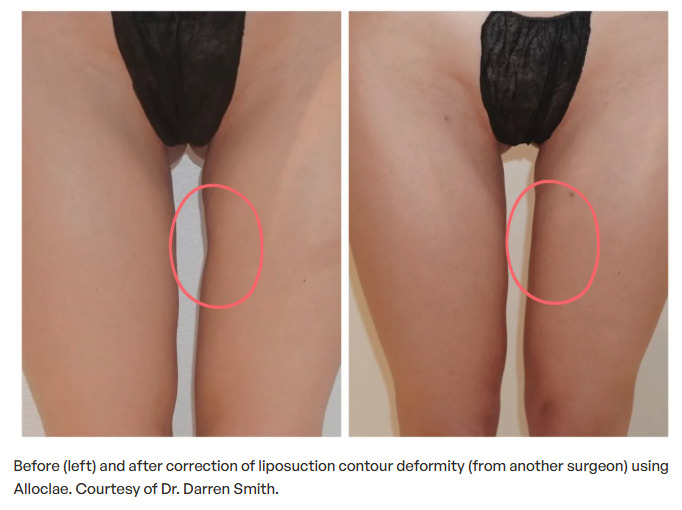
Early studies in lab models show that Alloclae integrates well with surrounding tissue and promotes temporary growth of fat cells and blood vessels. Some surgeons have observed excellent tissue acceptance in patients undergoing body contouring procedures. Currently, clinical trials in the U.S. are examining its use in hip dip correction, with several hundred patients having received injections for the breasts and hips.

Applications of Alloclae
Alloclae is ideal for conservative, non-surgical enhancements:
- Breast Augmentation: Provides modest volume increases, often between 25–50 ccs per side, with potential for multiple sessions to gradually reach the desired cup size. It can enhance cleavage, correct post-liposuction or implant irregularities, and restore volume lost after weight loss.
- Hip Dip Correction: Smooths depressions between hips and thighs for a more contoured silhouette.
- Buttocks and Body Contouring: Used in small amounts to provide lift and shape, especially in patients with limited fat for traditional grafting.
Alloclae delivers a natural, soft contour similar to fat, but with added lift and shape due to the concentrated formulation. Surgeons caution that it is intended for modest enhancements rather than dramatic augmentations.
Advantages Over Traditional Fat Transfer and Implants
- No liposuction needed: Avoids anesthesia, extended recovery, and donor-site complications.
- Non-surgical: Administered in-office with local anesthesia; patients can return home the same day.
- Stable volume retention: Early reports suggest retention of 90–100% of injected fat, compared with 50–60% typical of standard fat grafting.
- Safety: Donor fat is processed to minimize immunogenic risk.
Compared to implants, Alloclae provides a more natural shape that conforms to existing breast tissue rather than imposing a fixed form. Its texture is thicker than regular fat, providing lift and subtle contouring without major surgery.
Limitations and Considerations
While promising, Alloclae has some limitations:
- Lack of long-term clinical studies and formal FDA approval for aesthetic use.
- Volume is limited per session; multiple treatments may be required for significant enhancement.
- Not a replacement for implants in patients seeking substantial size increase or structural support.
- Potential side effects include bruising, swelling, soreness, fat necrosis, oil cysts, and underwhelming results, similar to traditional fat grafting.
Surgeons recommend conservative applications initially, particularly for the breasts. Gradual volume building ensures optimal tissue acceptance and reduces risks associated with overfilling.

- Patients seeking modest breast or body contouring without surgery.
- Individuals who are too thin for traditional fat grafting.
- Patients recovering from implant removal, liposuction irregularities, or weight loss-related volume loss.
Conclusion
Alloclae represents a potentially transformative option in regenerative aesthetics, bridging the gap between fat grafting and non-surgical cosmetic procedures. While long-term studies are still needed, surgeons report positive early results, particularly for subtle contouring and volume restoration. For patients who desire a natural, minimally invasive solution, donor fat injections may offer a new frontier in body sculpting.
Discover This: Global HIV Fight Threatened by Rising Criminalisation and US Funding Cuts, Warns UNAids
Editor’s Pick: Venus Williams Opens Up About 30-Year Battle With Uterine Fibroids and Her Life-Changing Surgery
Top Suggestion: Strength Training for Hormonal Health: Why Filipinas Are Lifting Weights
Alloclae fat transfer, donor fat injection, non-surgical fat grafting, body contouring, breast augmentation without implants, hip dip correction, fat transfer alternatives, regenerative aesthetics, cosmetic fat injections, liposuction alternative




.webp)

